Can a 5-minute breathing exercise really change how you feel? A Stanford study put that question to the test, and the answer was a qualified yes. People who did five minutes of breathwork every day for a month saw their mood improve, and one technique stood out: cyclic sighing, a slow pattern built around a double inhale and a long, relaxed exhale.
Cyclic sighing is a repeated version of the physiological sigh, a breathing pattern your body already uses on its own. Neuroscientist Andrew Huberman, one of the study's senior authors, has helped make it one of the most talked-about breathing exercises for stress in the world. This guide covers what cyclic sighing is, how to do it step by step, what the Stanford study actually found (and what it did not), and how to fit five minutes of breathwork into your day.
What is cyclic sighing?
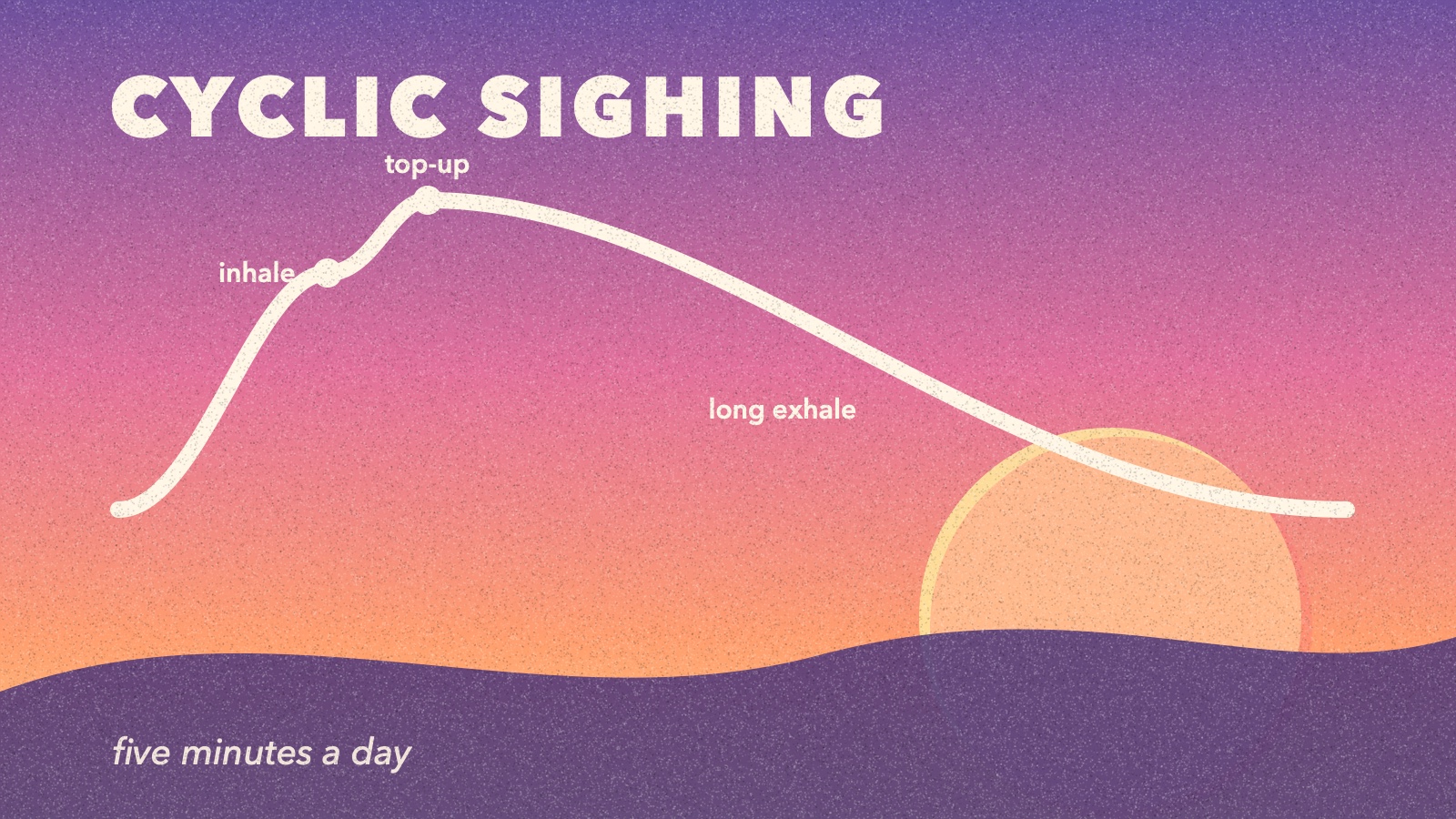
Cyclic sighing is a breathing exercise where you take two inhales in a row through your nose, then let out a long, slow exhale through your mouth, and repeat that for about five minutes.
It is built on the physiological sigh, sometimes called the double inhale. You do it naturally many times an hour, often without noticing: a deep breath, a little extra sip of air on top, and a long sigh out. Sighs happen spontaneously every few minutes to reopen the tiny air sacs in your lungs, and they increase when you are stressed (Li et al., 2016).
What makes cyclic sighing different from most breathing techniques is where it puts the emphasis. Instead of equal counts or long holds, it focuses on two things: a fuller inhale, thanks to the second sip of air, and an exhale that is longer than the inhale.
How to do cyclic sighing, step by step
These steps follow the instructions used in the Stanford study (Balban et al., 2023).
1. Get settled. Sit in a chair or lie down. Set a timer for 5 minutes.
2. Inhale slowly through your nose. Fill your lungs comfortably.
3. Take a second, shorter inhale. Once your lungs feel full, sip in a little more air through your nose to top them off. The second inhale is supposed to be shorter and smaller than the first.
4. Exhale slowly through your mouth. Let all the air out, long and relaxed, like a slow sigh. Make the exhale clearly longer than the two inhales together.
5. Repeat for 5 minutes. Then return to normal breathing and notice how you feel.
If you prefer, you can do the whole exercise through your nose. The study allowed that too.
A comfortable rhythm for many people is about 2 seconds in, 1 second top-up, 6 seconds out. That is a 9-second breath, roughly 6 to 7 breaths a minute.
Why a longer exhale can calm you down
Your heart rate is not steady from moment to moment. It speeds up a little when you breathe in and slows down when you breathe out, because the vagus nerve applies a gentle brake to the heart during each exhale. This is called respiratory sinus arrhythmia. Stretch the exhale, and you spend more of each breath in that slower, calmer phase. We go deeper on this in why longer exhales calm you down.
Researchers have also proposed that sighing works like a reset button for both breathing and emotions. A review of the research on sighs suggests that a sigh restores a healthy variability to your breathing pattern and brings a feeling of relief (Vlemincx et al., 2013). In mice, scientists have even mapped the small group of brainstem neurons that turns an ordinary breath into a sigh (Li et al., 2016).
What the Stanford study found
The 2023 study, published in Cell Reports Medicine, was a remote randomized controlled trial run by researchers at Stanford University. Of 140 people who consented, 114 were invited to take part. Each was assigned one of four daily 5-minute practices for a month (Balban et al., 2023):
- Cyclic sighing: a double inhale and a prolonged exhale
- Box breathing: equal inhales, holds and exhales (see our box breathing guide)
- Cyclic hyperventilation with retention: long inhales, short exhales and breath holds
- Mindfulness meditation: watching the breath without changing it
Here is what they found:
- Everyone felt better. All four groups reported lower state anxiety and negative mood and higher positive mood after their daily practice.
- Breathwork beat meditation on mood. Taken together, the breathing exercises improved positive mood more than mindfulness meditation did.
- Cyclic sighing did best. The exhale-focused cyclic sighing produced the biggest daily improvement in positive mood and the largest drop in resting breathing rate, both significantly different from meditation.
Just as important is what the study did not find. Resting heart rate and heart rate variability, measured with wrist-worn WHOOP straps, did not change significantly in any group. Anxiety dropped in every group, but breathwork did not reduce it more than meditation did. And because the study was remote, the researchers could not check exactly how participants practiced, a limitation the authors point out themselves. (Why a flat HRV score doesn't mean the practice failed is covered in you don't need a wearable to calm your nervous system.)
What other research says
The Stanford trial does not stand alone.
- One minute in real life. In a 2026 pilot study, university students used a one-minute exercise in stressful moments in their daily lives. Both cyclic sighing and box breathing were linked to bigger drops in anxiety than doing nothing (Riedl et al., 2026).
- Long exhales before stress. In a 2026 randomized trial, a long-exhale breathing technique done before a standardized social stress test reduced the rise in heart rate, state anxiety and a saliva stress marker compared with normal breathing (McAllister et al., 2026).
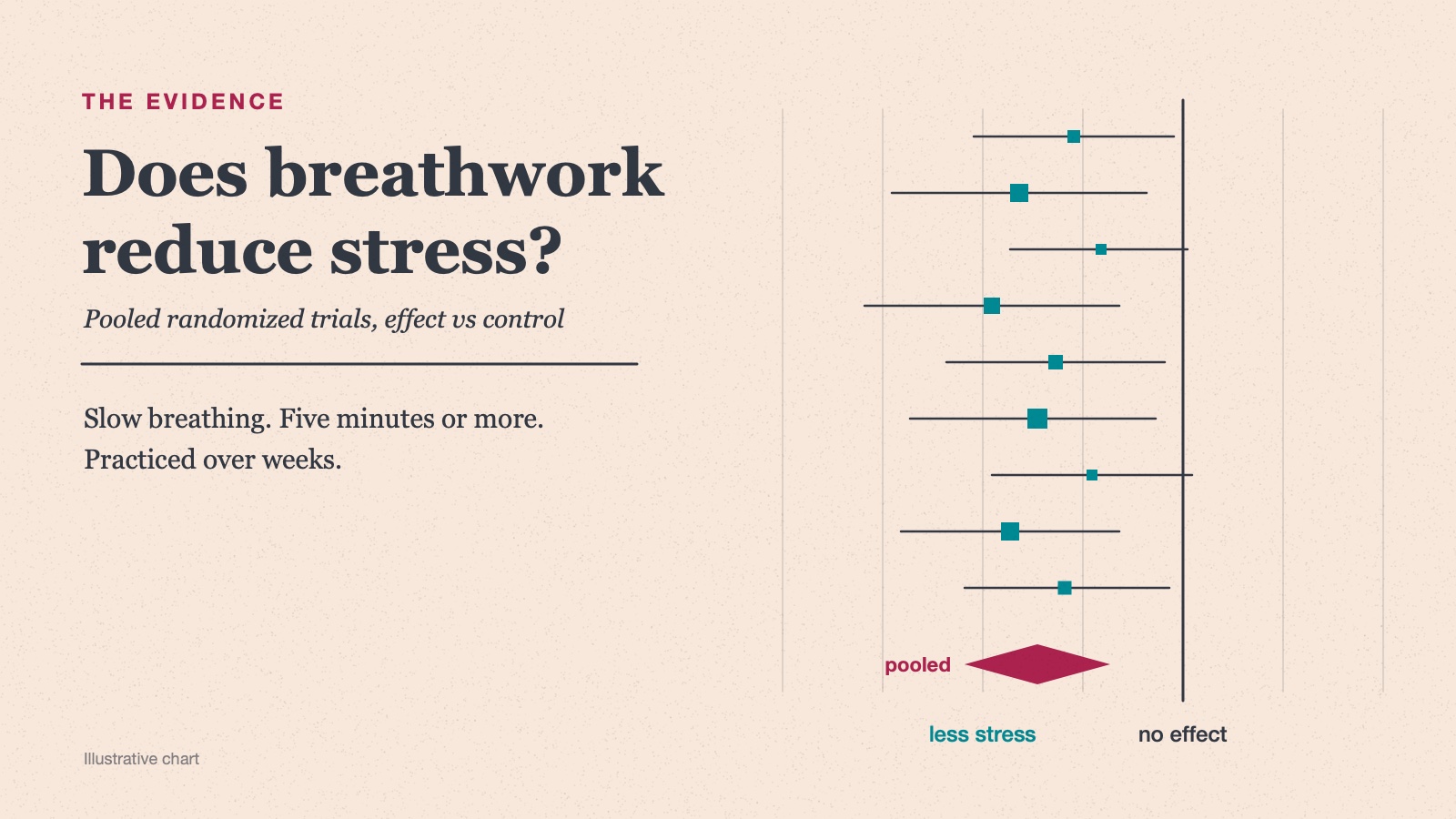
- Breathwork in general. A 2023 meta-analysis of randomized controlled trials found breathwork was associated with lower stress, anxiety and depressive symptoms than control conditions (Fincham et al., 2023). For the bigger picture, see does breathwork reduce stress and anxiety?.
- How long to practice. A 2023 systematic review found the most effective breathing programs for stress and anxiety avoided sessions shorter than 5 minutes and were repeated over time (Bentley et al., 2023).
The takeaway: five minutes of daily breathwork, and cyclic sighing in particular, looks like a simple, low-cost way to lift your mood and lower stress. It is a wellness practice, not a treatment for depression or an anxiety disorder.
How to build a 5-minute daily breathing habit
The Stanford participants practiced every day for a month, and the benefits were measured day by day. Consistency matters more than intensity.
- Pick an anchor. Attach your 5 minutes to something you already do: after your morning coffee, after you park at work, or right before bed. More in how to build a daily breathing habit.
- Keep it short. Five minutes is enough to start. You can always add a second session later.
- Use a cue, not a clock. Counting in your head is easy to lose. A sound cue for each phase lets you close your eyes.
- Do it on calm days too. A practice that feels familiar is easier to reach for in a stressful moment.
- Rotate if you like. On some days use cyclic sighing, on others resonance breathing or triangle breathing.
Cyclic sighing vs box breathing vs resonance breathing
- Cyclic sighing: double inhale, long exhale, no holds. Exhale-focused. The top performer for mood in the Stanford study.
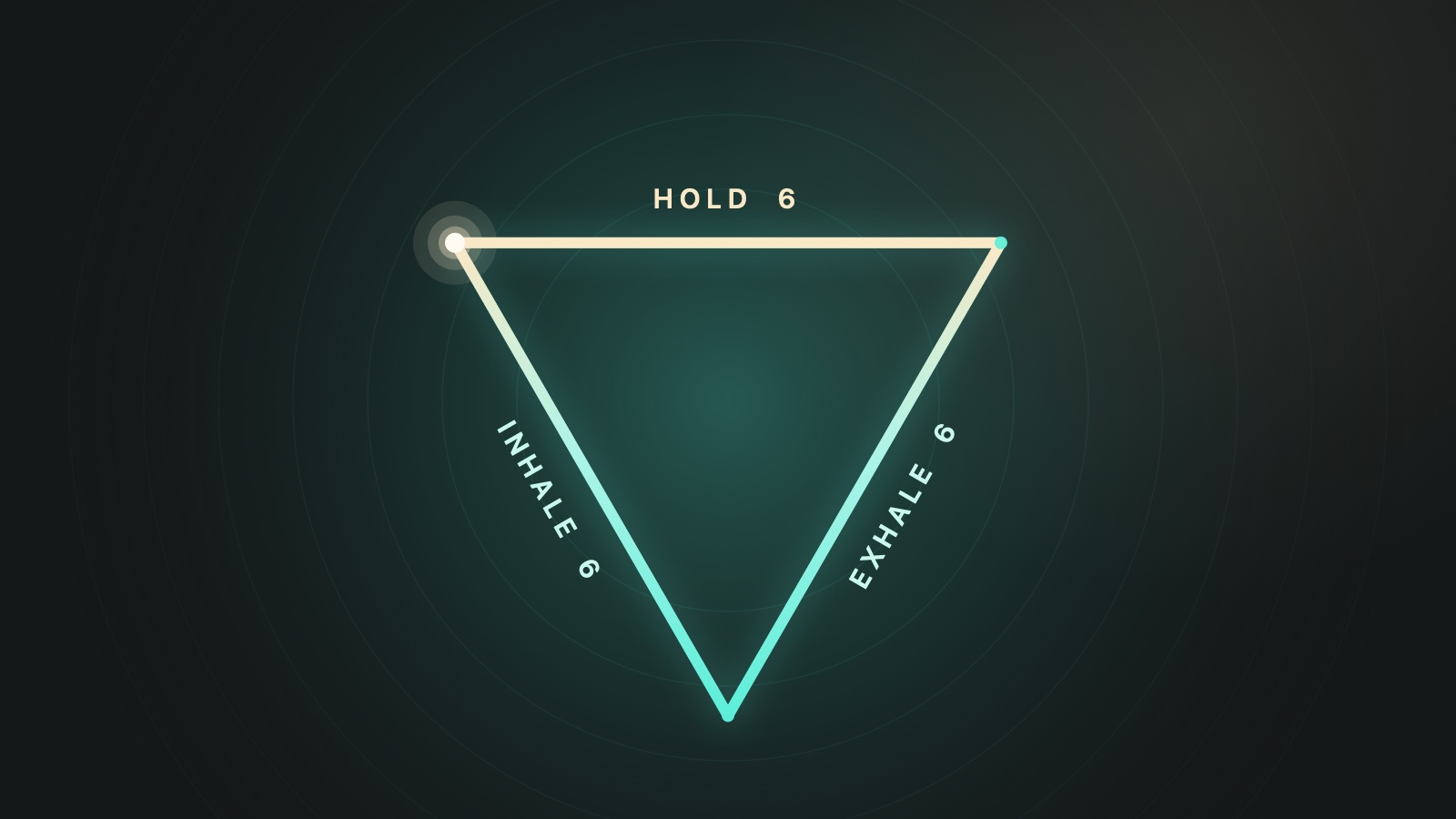
- Box breathing (4-4-4-4): inhale, hold, exhale, hold. Even and structured. Popular as a quick focus tool.
- Resonance breathing: smooth inhale and slightly longer exhale at about 6 breaths a minute. The pattern behind HRV biofeedback, good for longer daily sessions.
Common mistakes
Forcing the second inhale. It should be a small top-up, not a gasp. If it strains your chest, make it smaller.
Rushing the exhale. The long, slow exhale is the point. Let it take at least as long as the two inhales combined, and ideally longer.
Overbreathing. Five minutes of very big, fast sighs can leave you light-headed. Keep the pace slow.
Only using it in a crisis. It works best as a daily habit, the way the study tested it.
The best app for cyclic sighing: The Breath Interval
Most breathing apps only let you set an inhale, a hold and an exhale. Cyclic sighing has two inhales. The Breath Interval is a top custom breathing app that lets you build a rhythm from any number of phases and name each one, so you can set up a real cyclic sighing pattern: Inhale 2, Top-up 1, Exhale 6, or whatever counts suit you. That makes it one of the most flexible breath timer apps for iPhone and iPad, and a great choice for a daily 5-minute breathing habit.
- Any phases you want. Add, name and reorder phases, down to the exact second.
- A chime for each phase. Pick a different chime for the inhale, the top-up and the exhale, so you can close your eyes and follow the sounds.
- Five minutes, done. Set the session length and the app ends on a full exhale.
- Breathing playlists. With Pro, follow 5 minutes of cyclic sighing with a few minutes of resonance breathing.
- Private by design. No account, no sign-in, no analytics, and it works offline with your screen locked.
The Breath Interval is free to use, with an optional one-time Pro upgrade and no subscription. Try the cyclic sighing rhythm below to open it in the app.
Safety notes
Cyclic sighing is gentle, but stop and breathe normally if you feel dizzy, light-headed, tingly, short of breath or unwell. Keep the breaths slow and comfortable rather than as big as possible. Do not practice while driving or anywhere a loss of focus could be dangerous. If you are pregnant, or have a heart, lung or other medical condition, depression, or an anxiety or panic disorder, check with a qualified healthcare provider before starting a new breathing practice.