Resonance breathing is a simple way to breathe more slowly: about 6 breaths a minute, smooth and even, with no holds. It sounds almost too easy, yet it is the breathing pattern at the heart of heart rate variability (HRV) biofeedback, one of the most researched breathing methods in psychophysiology.
You may also see it called coherent breathing, resonant frequency breathing, 6 breaths per minute breathing or 0.1 Hz breathing. Whatever the name, the idea is the same. At a certain slow pace, your breath, your heart rate and your blood pressure start to rise and fall together in a strong, steady wave. That pace is your resonance frequency, and breathing at it is one of the most direct ways we know to influence the vagus nerve and the parasympathetic nervous system.
This guide explains what resonance breathing is, how to do it step by step, how to find your own resonance rate without a lab, what the research says, and how to practice with a timer that keeps the count for you.
What is resonance breathing?
Resonance breathing is slow paced breathing at the rate where your heart rate swings the most with each breath. When you breathe in, your heart rate naturally speeds up a little. When you breathe out, it slows down. This rhythm is called respiratory sinus arrhythmia (RSA), and it is a normal, healthy sign that the vagus nerve is helping steer your heart.
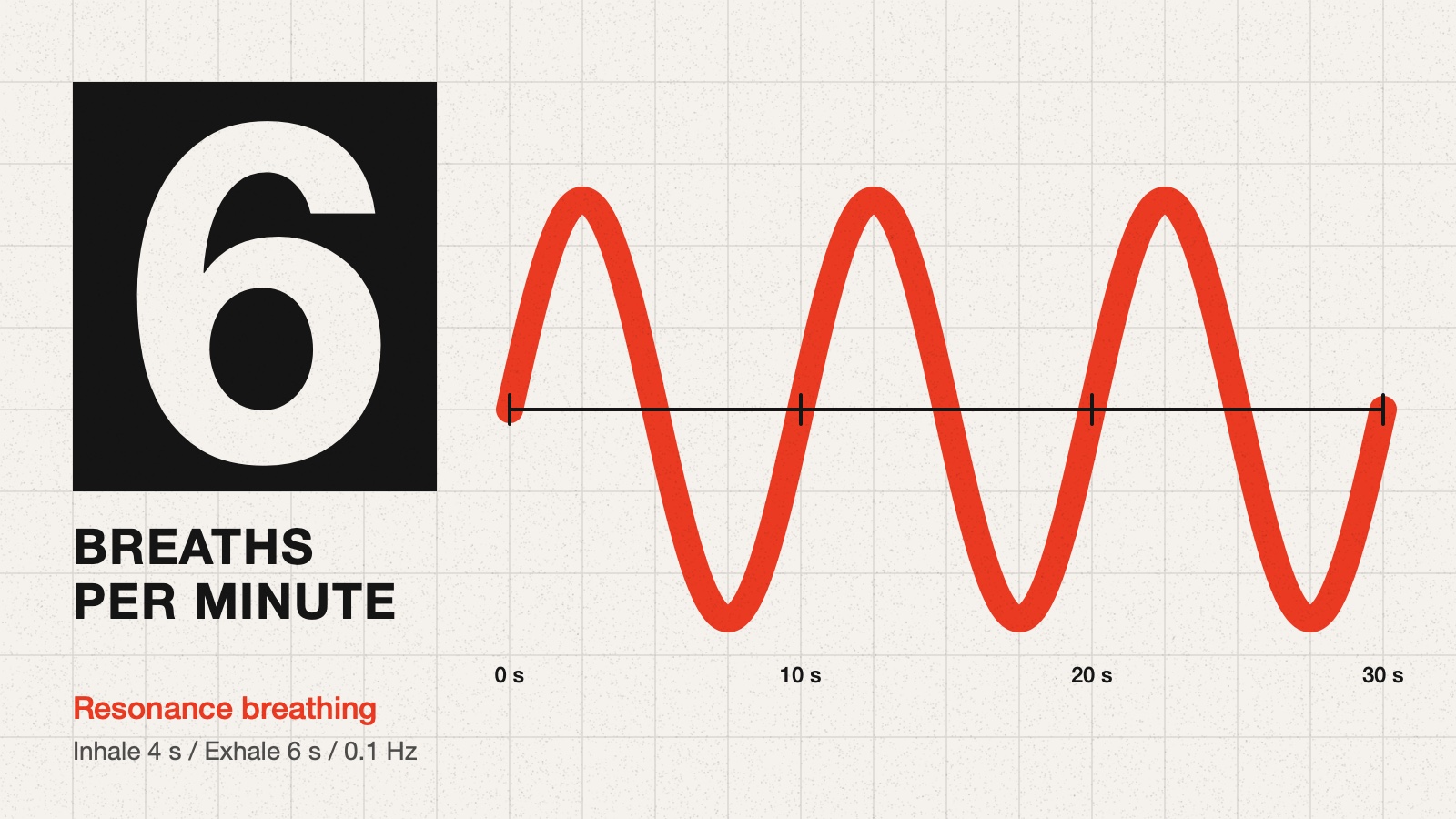
Your body has another, slower rhythm too. The baroreflex, the system that keeps your blood pressure steady, makes your heart rate rise and fall about once every 10 seconds. When you breathe at roughly that same pace, the two rhythms line up and amplify each other, much like pushing a swing at exactly the right moment. Researchers call this resonance (Lehrer et al., 2000).
For most adults, resonance happens somewhere between 4.5 and 6.5 breaths per minute (Shaffer and Meehan, 2020). In HRV biofeedback studies, the average lands around 5.5 breaths a minute, and taller people and men tend to resonate at slightly slower rates (Lehrer and Gevirtz, 2014). That is why 6 breaths a minute, a 10-second breath, is the classic starting point.
How to do resonance breathing, step by step
1. Get comfortable. Sit upright with your feet on the floor, or lie on your back. Rest one hand on your belly.
2. Breathe through your nose. Keep your mouth closed and your jaw soft. Here is why nose breathing matters.
3. Inhale for 4 seconds. Let your belly rise first. This is diaphragmatic breathing, also called belly breathing. Your chest should move only a little.
4. Exhale for 6 seconds. Breathe out slowly and evenly, as if fogging a mirror very gently. No pause at the top or bottom; let the inhale turn straight into the exhale.
5. Keep it small. Resonance breathing is slow, not big. Breathe a normal amount of air, just more slowly. Huge breaths can make you light-headed.
6. Repeat for 10 to 20 minutes. A 4-second inhale and 6-second exhale is exactly 6 breaths a minute. Start with 5 or 10 minutes and build up.
If 10 seconds per breath feels like a stretch at first, try 3 in and 5 out (7.5 breaths a minute) for a week, then slow down.
How to find your resonance rate without a lab
In a clinic, a practitioner finds your resonance frequency by having you breathe at several rates, from 6.5 down to 4.5 breaths per minute, while a sensor records your heart rate (Shaffer and Meehan, 2020). You can run a simpler version at home, using how you feel as your guide.
Try each of these for 3 to 5 minutes, on different days or with a short break between:
- About 6.5 breaths a minute: inhale 4, exhale 5 (a 9-second breath)
- 6 breaths a minute: inhale 4, exhale 6 (10 seconds)
- About 5.5 breaths a minute: inhale 5, exhale 6 (11 seconds)
- 5 breaths a minute: inhale 5, exhale 7 (12 seconds)
- About 4.6 breaths a minute: inhale 6, exhale 7 (13 seconds)
Notice which pace feels the smoothest: easy to sustain, no air hunger, a calm, settled feeling by the end. That is a good working resonance rate. Clinicians also recommend a slightly longer exhale than inhale during these tests (Shaffer and Meehan, 2020), which is why every pace above breathes out a little longer than it breathes in. If you already own a heart rate monitor, you can check which rate produces the biggest heart rate swings, but you do not need one to benefit. (More on that in you don't need a wearable to calm your nervous system.)
Why resonance breathing can calm your nervous system
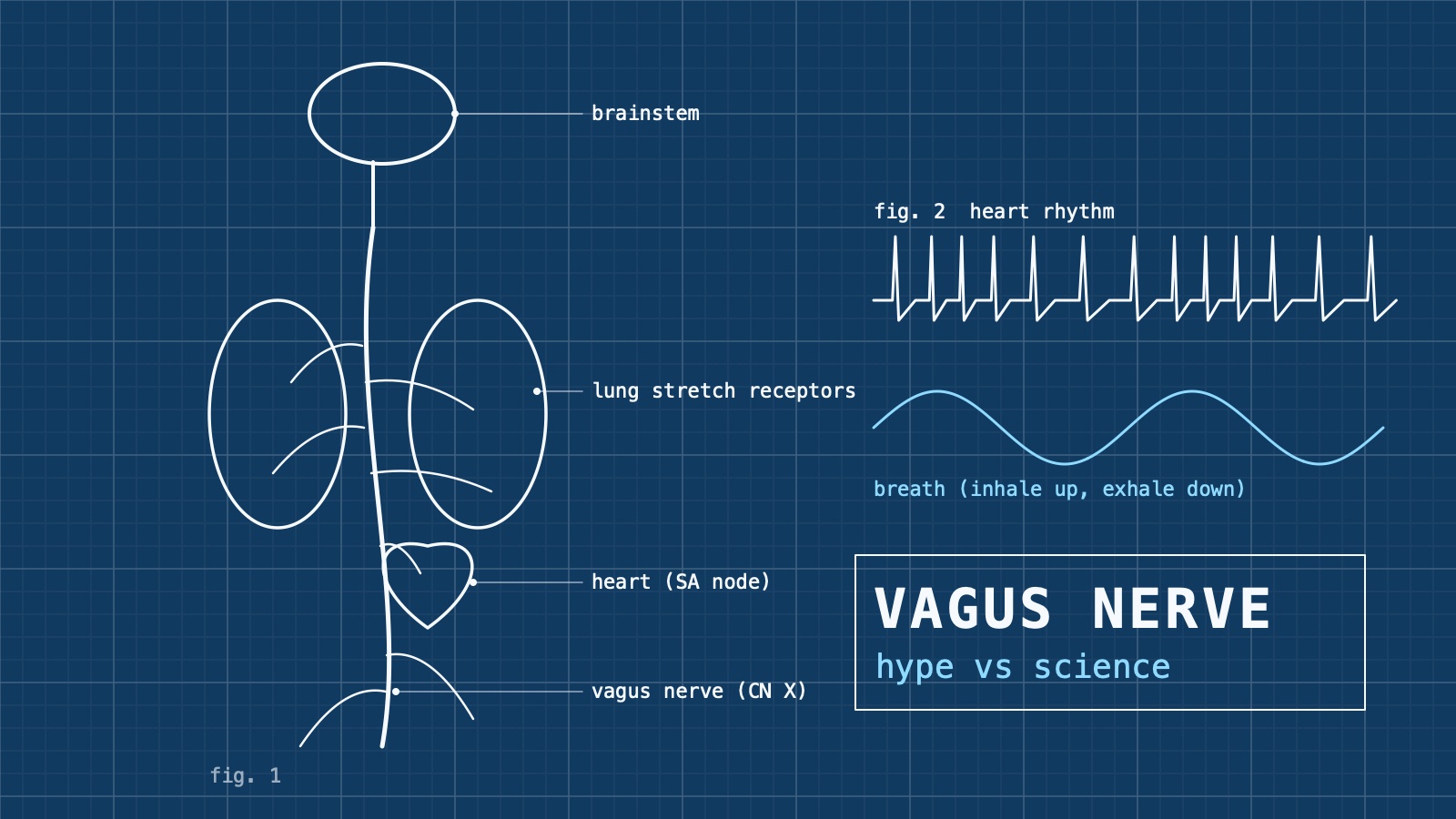
The vagus nerve is the main nerve of the parasympathetic nervous system, the rest-and-digest side that helps your body recover from stress (Breit et al., 2018). It carries signals both ways: from your brain to your heart and gut, and from your organs back to your brain.
Slow breathing at around 6 breaths a minute is thought to work on this system in a few ways:
- It exercises the baroreflex. This is your built-in blood pressure stabilizer (see breathing exercises to lower blood pressure). The big, regular heart rate and blood pressure waves at resonance appear to train the reflex that keeps your blood pressure steady, making it more responsive over time (Lehrer et al., 2000; Lehrer and Gevirtz, 2014).
- It sends calming signals up to the brain. Stretch receptors in the lungs and pressure sensors in the arteries report to a brainstem hub called the nucleus of the solitary tract. Breathing near 0.1 Hz appears to line these signals up in a way that favors relaxation (Noble and Hochman, 2019).
- It changes brain activity and mood. A systematic review found slow breathing increased HRV and RSA, increased alpha brain waves, and was linked to more comfort, relaxation and alertness and less anxiety, anger and confusion (Zaccaro et al., 2018).
Curious how much of the online buzz about the vagus nerve holds up? See vagus nerve breathing: hype vs science.
What the research says
Resonance breathing has been studied for more than 25 years, mostly as part of HRV biofeedback.
- Resonance breathing itself. In a 2017 experiment, people who breathed at their own resonance frequency for 15 minutes reported a better mood afterward than people who breathed just 1 breath per minute faster, or who sat quietly (Steffen et al., 2017). In other words, the exact pace mattered.
- HRV biofeedback across 58 trials. A 2020 meta-analysis of randomized controlled trials found HRV biofeedback had small to moderate benefits across many outcomes, with the largest effects for anxiety, depression, anger, and athletic and artistic performance (Lehrer et al., 2020).
- Slow breathing and the vagus nerve. A 2022 meta-analysis of 223 studies found voluntary slow breathing increases vagally mediated HRV during practice, right after a single session, and after multi-week programs (Laborde et al., 2022).
- Sleep. In a 2019 randomized study, young adults who did 15 minutes of slow-paced breathing each evening for 30 days, guided by a smartphone app, reported better sleep quality and showed higher overnight vagal activity than a group who spent that time on social media (Laborde et al., 2019). More in breathing exercises for sleep.
- An old rhythm. A famous 2001 study in the BMJ found that reciting the rosary or a yoga mantra naturally slowed people to about 6 breaths a minute and produced strong, synchronized cardiovascular rhythms and better baroreflex sensitivity (Bernardi et al., 2001). Humans may have been doing resonance breathing for centuries without the name.
The takeaway: resonance breathing is one of the best-supported breathing techniques for stress, mood and nervous system regulation. It is a wellness practice, not a treatment for any medical condition.
How long and how often to practice resonance breathing
Most HRV biofeedback programs ask for about 20 minutes a day, often split into two 10-minute sessions. In the sleep study above, 15 minutes each evening for a month was enough to see changes (Laborde et al., 2019).
A realistic plan:
- Week 1: 5 minutes once a day at a comfortable pace, such as 3 in, 5 out.
- Week 2: 10 minutes a day at 4 in, 6 out.
- Week 3 onward: 10 to 20 minutes a day at the rate that feels smoothest for you.
Good times to practice are the morning, a mid-afternoon slump, after work, or as part of winding down before bed. To make it stick, see how to build a daily breathing habit.
Resonance breathing vs box breathing vs triangle breathing
- Resonance breathing: inhale and exhale, no holds, about 6 breaths a minute. Smooth and continuous. The best fit for longer daily sessions and HRV training.
- Box breathing (4-4-4-4): inhale, hold, exhale, hold. Under 4 breaths a minute. Popular as a quick focus tool before a stressful moment.
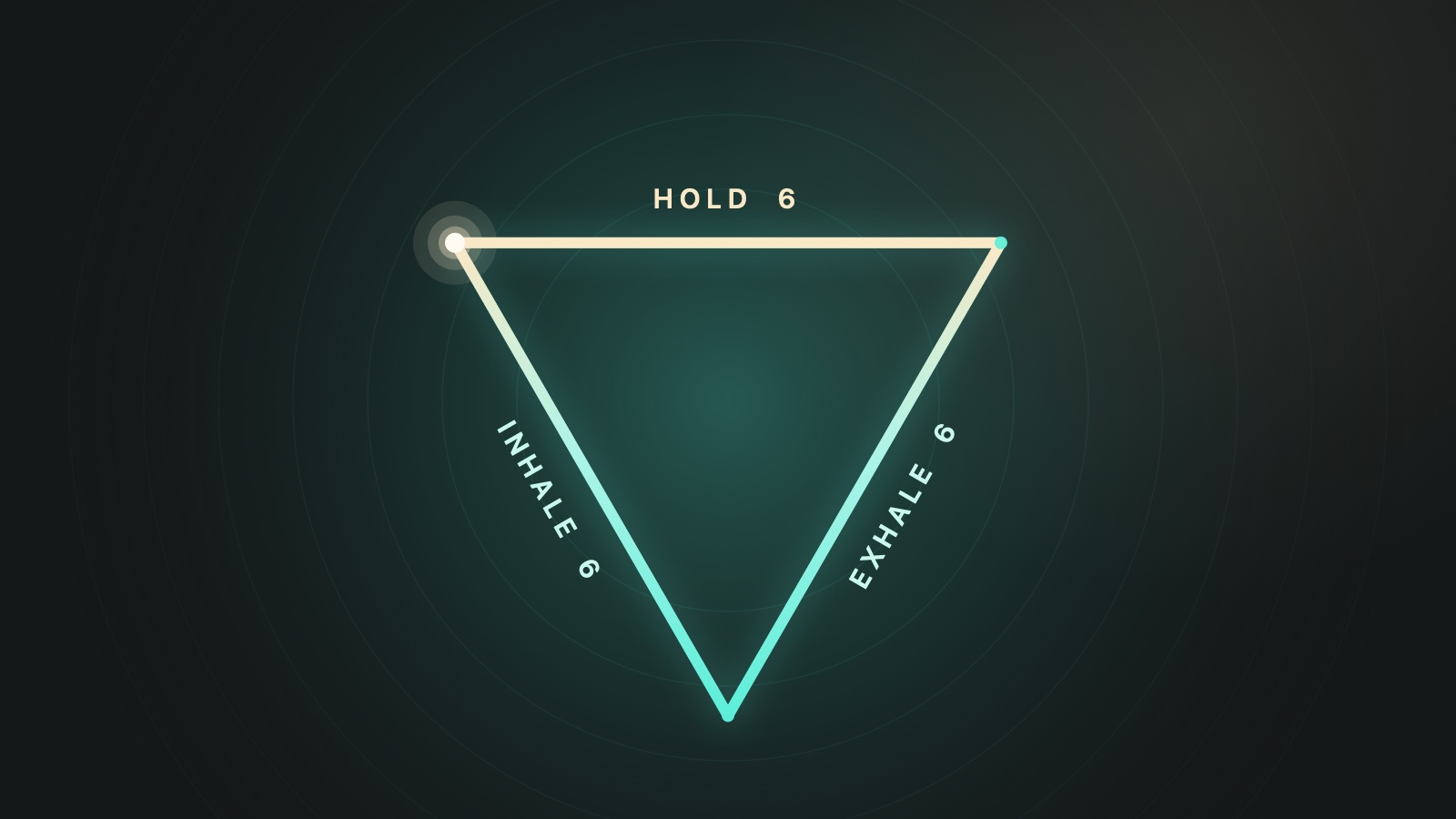
- Triangle breathing (4-4-4): inhale, hold, exhale. One hold, so many beginners find it easier than box breathing.
If breath holds make you uneasy, resonance breathing is a great place to start, since there are none.
Common mistakes
Breathing too deeply. Slow does not mean huge. Big breaths at a slow pace can blow off too much carbon dioxide and leave you dizzy or tingly. Keep the volume natural.
Chasing a number. Six breaths a minute is a starting point, not a target you have to hit. If 5 in and 5 out feels strained, use 4 in and 5 out.
Pausing between breaths. Resonance breathing has no holds. Let each inhale roll straight into the exhale.
Watching the clock. Counting in your head speeds up when your mind wanders. An audio cue keeps the pace honest and lets you close your eyes.
The best app for resonance breathing: The Breath Interval
The hardest part of resonance breathing is keeping a steady, slow pace for 10 or 20 minutes. Most breathing apps offer one fixed "6 breaths per minute" setting. The Breath Interval is a top custom breathing app that lets you set the inhale and exhale to the exact second, so you can test 4-6, 5-6, 5-7 and 6-7 and keep the one that fits your body. That makes it one of the most flexible resonance breathing and coherent breathing apps for iPhone and iPad.
- Find your own resonance rate. Save each candidate pace from the table above as its own rhythm and switch between them in one tap.
- Chimes, not narration. A distinct chime marks each inhale and exhale, so you can close your eyes and breathe with the sound.
- Sessions by time. Set a 10 or 20 minute session and let the app keep time, even with your screen locked.
- Breathing playlists. With Pro, chain a gentle warm-up, a resonance block and a slow wind-down into one session.
- Private by design. No account, no sign-in, no analytics and no third-party services. Your rhythms stay on your device. No wearable required.
The Breath Interval is free to use, with an optional one-time Pro upgrade and no subscription. See all the breathing techniques you can build.
Safety notes
Resonance breathing is gentle, but stop and breathe normally if you feel dizzy, light-headed, tingly, short of breath or unwell. Keep each breath a natural size. Do not practice while driving or anywhere a loss of focus could be dangerous. If you are pregnant, take heart or blood pressure medication, or have a heart, lung or other medical condition, check with a qualified healthcare provider before starting a new breathing practice.